Confirm section ownership, speaking order and outstanding technical actions.
EG334S Smart Multi-Cloud Project
Hybrid Enterprise Multi-Cloud Architecture
Three connected cloud environments, two explicit Site-to-Site VPNs and a resilient two-Availability-Zone application tier in Ireland—supported by monitored recovery and controlled teardown.
3 cloud cells
2 IPsec paths
Non-transitive VGW routing
Two-AZ application tier
10-minute recovery objective
School deployment · accepted operating environment
School AWS · integrated live hub ACCEPTED
The authorised school deployment is operational under the eg334s-team2 project prefix. Its internet-facing Application Load Balancer spans eu-west-1a and eu-west-1b and distributes HTTP traffic across Web Node 1 (10.1.1.119) and the current Auto Scaling-managed Web Node 2 (10.1.2.146).
School AWSLIVE · ACCEPTED · Virginia and Ireland stacks deployed in account
427617722186School AzureLIVE · CONNECTED · East Asia workload and VPN #2 in
eg334s-team2-rgLoad balancingPASS · two healthy targets · one in each Ireland Availability Zone
Hub resilienceACTIVE-ACTIVE · one running instance in each Availability Zone · ASG desired capacity 1
VPN #1DUAL-TUNNEL BGP · 2/2 ESTABLISHED · route-based VTI interfaces · dynamic prefix exchange · automatic convergence
Last reconciled6 Aug 2026 · obsolete static VPN #1 retired, current BGP path verified and both ALB targets healthy
Claim boundary. Test 10 abruptly stopped the eu-west-1a application target without deregistration or draining. Across 203 one-second requests, 198 returned HTTP 200 and five transient failures were retained while ALB health detection converged in 36.8 seconds. The eu-west-1b target remained healthy and served 129 responses; both targets and private-path pings finished healthy. This proves active-active application resilience, not zero-interruption failover, whole-AZ failure or regional HA.
Decommission deadline
--
Sun 30 Aug 2026, 23:59 SGT · official penalty applies to AWS resources left running
Project week
1 / 5
Plan & set up (ahead: AWS build already live)
Milestones done
4 / 6
M1 + M2 + M3 + M4 · the system works
Programme readiness
AMBER
Engineering proven · people, approval, demo and closure gates remain
1What we are judged onThe standard, first. Nothing further down this page can be judged without it.
Assessment · official weighting (Project Information §4)
Checkpoint
30%
Individual · problem-solving, ownership, attendance
Presentation
30%
Individual · delivery, slides, Q&A
System demo
20%
Technical / team · completeness & troubleshooting
Report
20%
Group · neatness, clarity, logical flow
60% is individual (Checkpoint + Presentation). Build the system as a team; own and defend your own section alone.
Presentation rubric · what assessors score (individual, 30%)
| Performance indicator | Excellent (top band) | What it takes |
|---|---|---|
| Organisation & Content (60) Organisation & supporting materials; Content |
Agenda exists, coherent & interesting sequence; supporting materials used innovatively & explained in context; can explain all details, constraints and work-arounds. | Have a clear agenda; every diagram/screenshot explained in context; be able to explain the whole project's details, limits and how you worked around them. |
| Presentation Skills (40) Delivery; Q&A |
Interesting, eloquent, enthusiastic delivery (not heavily scripted); handles all Q&A well and anticipates questions. | Rehearse so you're not reading slides; pre-empt likely assessor questions and prepare answers. |
Report rubric · what assessors score (group, 20%)
| Performance indicator | Excellent (top band) | What it takes |
|---|---|---|
| Report Presentation (20) Writing; Presentation & supporting materials |
Exceptionally clear, precise, concise English; few typos; professional layout; all illustrations well formatted. | Proofread hard; consistent styles/margins; clean, labelled figures and screenshots. |
| Technical Content (30) Organisation & structure; Literature survey; Quality of analysis |
Structure entirely correct, all sections placed; exemplary range of references; well-informed, authoritative discussion of a complex problem with depth. | Use a logical, complete structure; cite an exemplary range of authoritative references; show reasoned technical analysis, not just description. |
Verified on 27 Jul 2026 against the supplied official Presentation Assessment Rubrics and Report Assessment Rubrics PDFs. Presentation is marked out of 100 (60 + 40); the report rubric has 50 rubric marks (20 + 30) and the report contributes 20% of the module assessment.
Report requirements & structure (Project Information §5)
Working section-order proposal PROVISIONAL
Not yet confirmed by the team. The brief labels its contents page as a sample for reference only, so the order and owner chips shown here are planning placeholders. Use the matrix to develop the proposal; do not treat it as the approved Responsibility Assignment Table. Changes save to the shared planning matrix that every visitor sees.
Must include
- start Responsibility Assignment Table (name, admin no., role, topic, section, remarks)
- evidence Diagrams, screenshots, YAML files & configuration
- refs Bibliography of all references cited (incl. URLs)
- format Cover page + content page
- submit Softcopy uploaded to PoliteMall by due date
Scope & tasks (Project Information §3) · built with Amazon Q → CloudFormation YAML
Networks & compute
IPSec site-to-site VPN
Bonus marks (only after M4 · core working)
High availability & load balancing of web servers
Auto-scaling + simulated load test
CloudWatch + CloudTrail + VPC Flow Logs (Bernard's slice)
2Where we standWhere we are against that standard, and the system it refers to.
Operator console · one-click checks
Plain-spoken console for the assessors. These buttons do not fake the network. They open the exact live-check or evidence path and show the command we use for that scenario.
Live actions
Pick a check, show the command, then jump straight to the evidence.
Live multi-cloud overview
reading state…
Live status · current two-VPN topology
VPN #1 + #2 CURRENTVPN #1 · on-prem ↔ AWS public
Tunnel 1ESTABLISHED ·
34.252.232.43 · BGP route learned · preferredTunnel 2ESTABLISHED ·
52.208.125.123 · BGP route learnedInterpretationVPN #1 is route-based and dual-established. BGP local preference normally selects Tunnel 1; Tunnel 2 remains eligible for automatic convergence.
Accepted data-plane test0% loss to
10.1.1.119, ttl 254, ~69 ms · dated evidence; live tunnel state is shown aboveDesignstrongSwan CGW ↔ AWS VGW · IKEv2 · BGP ASN
65000 ↔ 64512PathN. Virginia ↔ Ireland (trans-Atlantic)
Alarm…
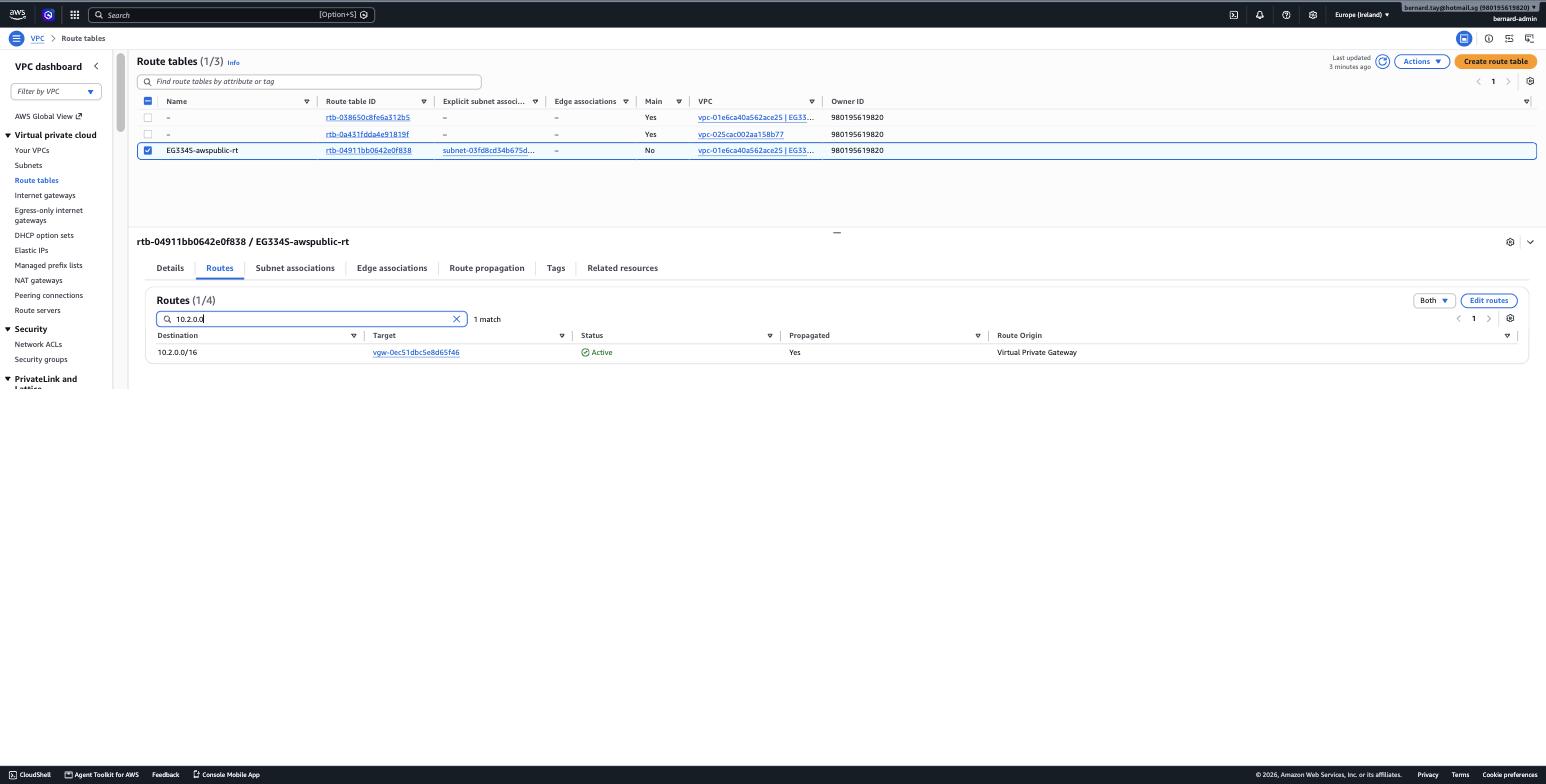
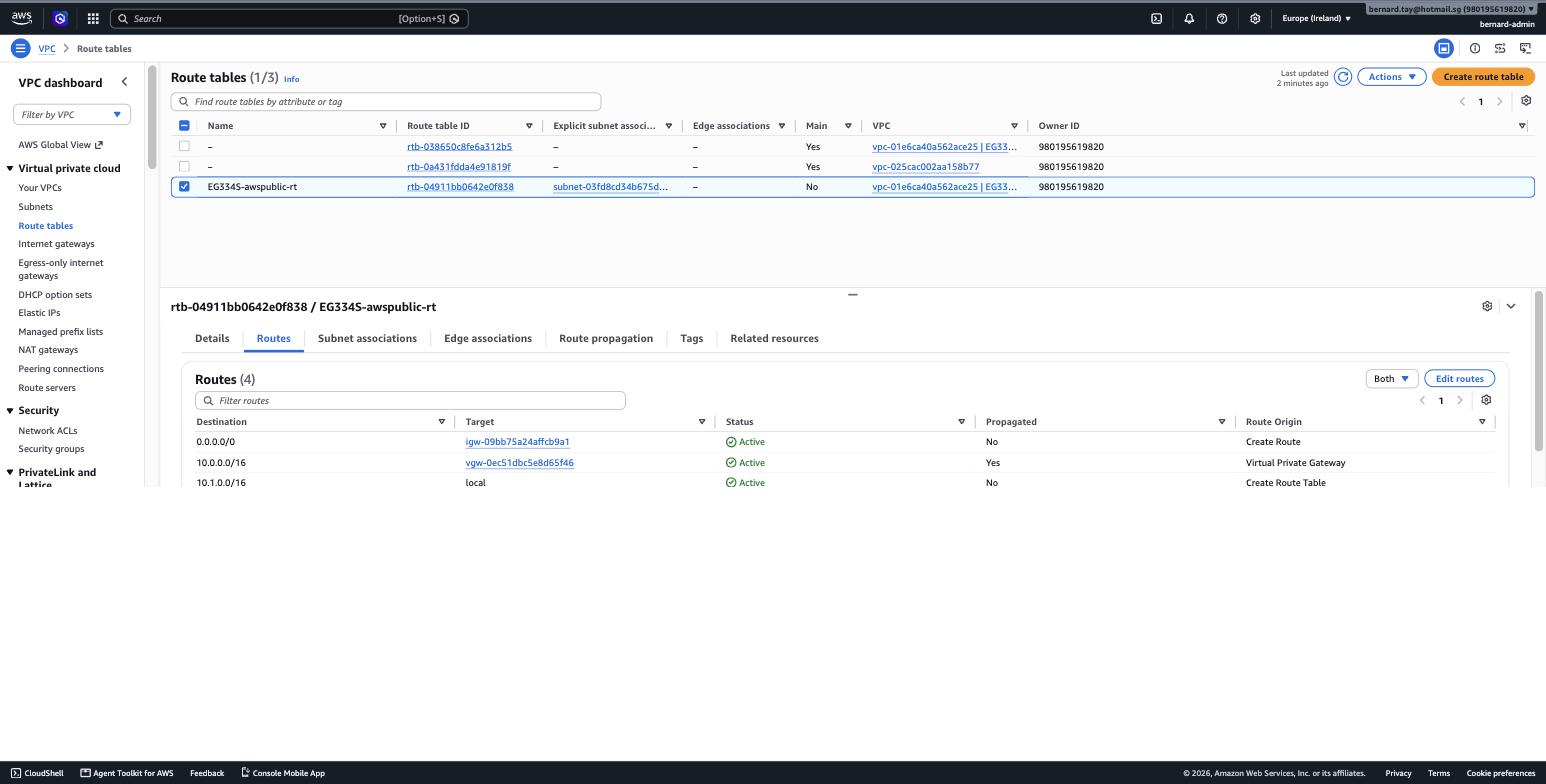
Hub route
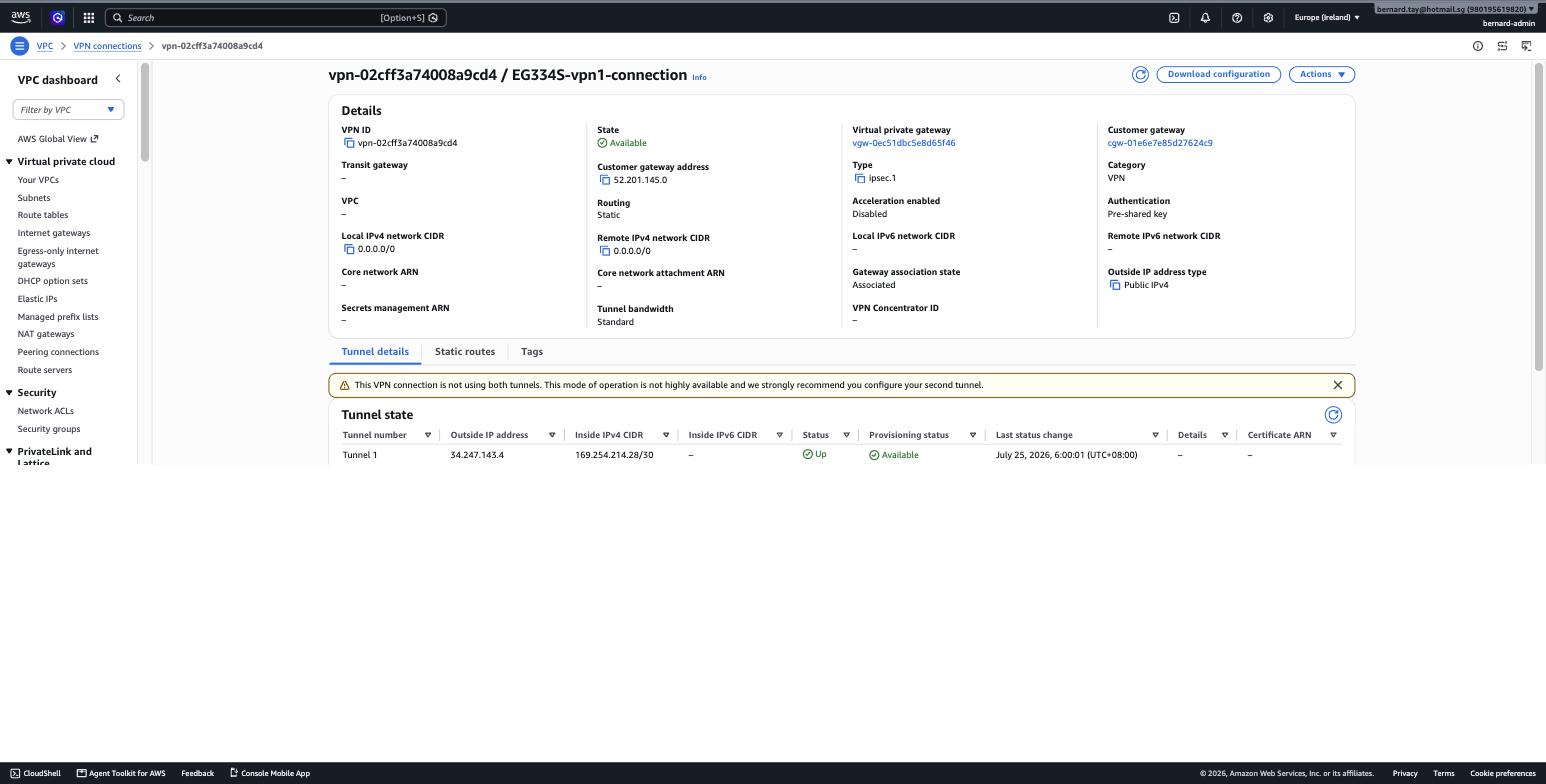
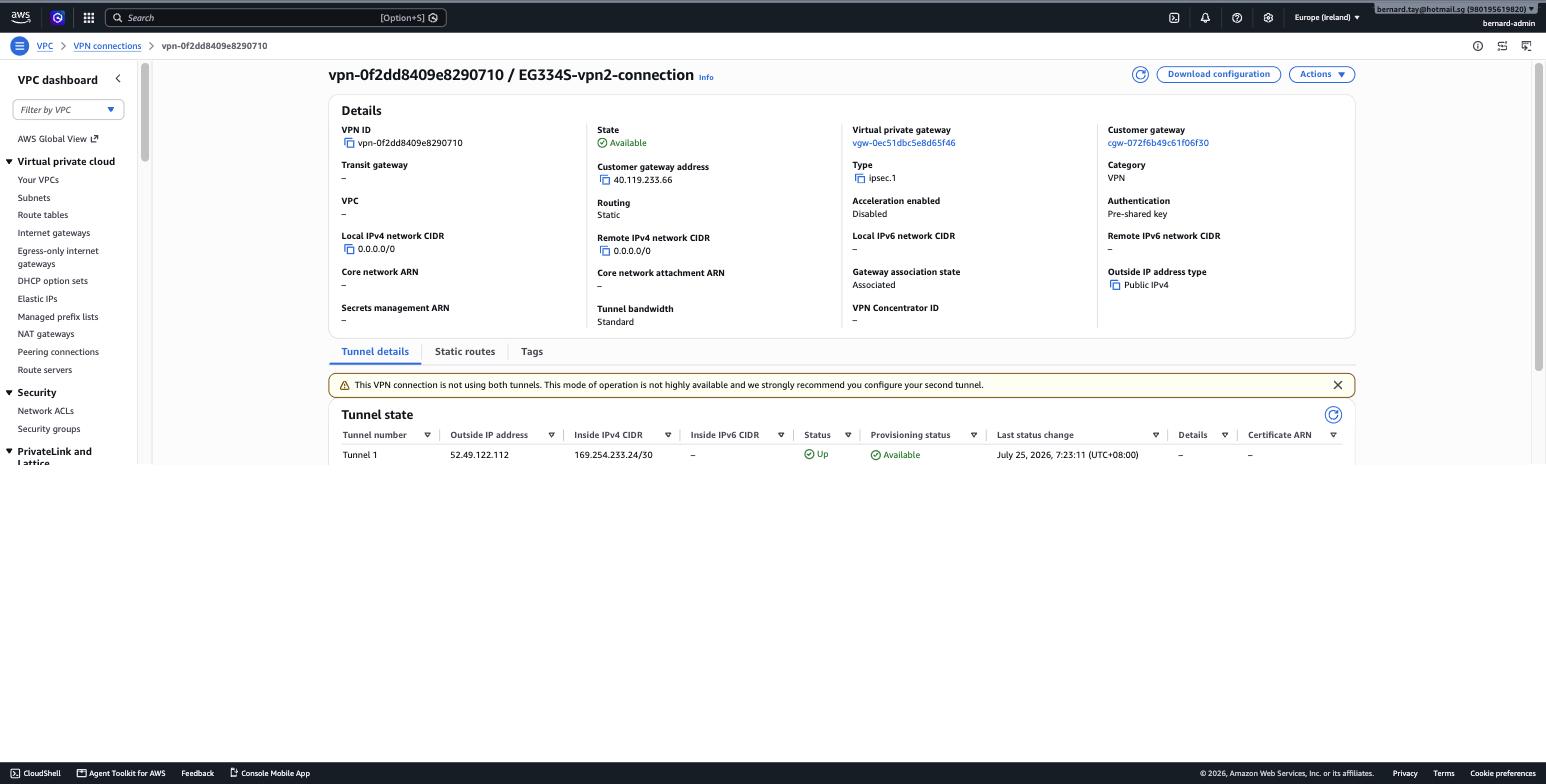
10.0.0.0/16 present in the eu-west-1 route table, learned by propagation, not typedVPN #2 · AWS public ↔ Azure
Tunnel 1 · preferredESTABLISHED · AWS endpoint
52.51.60.239 · Azure routing weight 10Tunnel 2 · standbyESTABLISHED · AWS endpoint
52.211.121.132 · Azure routing weight 0Interpretation2/2 static IKEv2 tunnels established through one AWS VPN connection. Azure is active-standby and BGP is disabled; failover may cause a brief convergence interruption.
Data planeAzure reports ingress and egress traffic counters; repeat the private ICMP and HTTP commands in the team lab immediately before the assessed demonstration.
DesignAzure VpnGw1AZ ↔ AWS VGW, IKEv2
PathIreland ↔ East Asia (Hong Kong), approximately 9,800 km
Alarm…
Routing boundaryAzure and Virginia are not connected through the Ireland VGW; AWS VGW does not forward traffic between VPN connections.
Application-layer proof
VPN #2 only
VPN #2 only
curl http://10.1.1.119 from the Azure VM returned the AWS web server page, now served by the template itself · a real workload across clouds. VPN #1 was proven with ICMP, not HTTP, so this row does not apply to it.Hub routingeu-west-1 carries
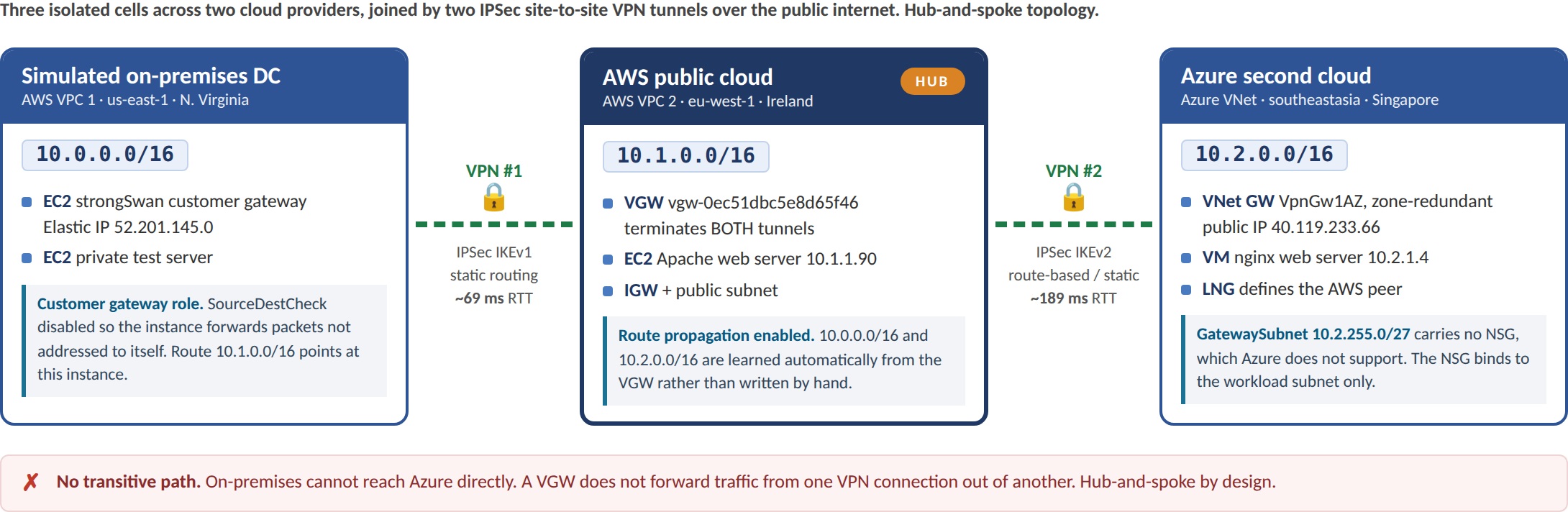
10.0.0.0/16 from VPN #1 and 10.2.0.0/16 from VPN #2. Azure↔Virginia transit is outside scope because the VGW is intentionally non-transitive.Known by design: on-prem cannot reach Azure directly (tested: 100% loss). An AWS VGW does not do transitive routing between two VPN connections. Topology is hub-and-spoke with AWS public as the hub, matching the brief. Full mesh would need a Transit Gateway.
On-prem DC
AWS VPC 1 · us-east-1
N. Virginia · 10.0.0.0/16
N. Virginia · 10.0.0.0/16
…
HUB
AWS public
AWS VPC 2 · eu-west-1
Ireland · 10.1.0.0/16
Ireland · 10.1.0.0/16
…
Azure VNet
East Asia (Hong Kong)
10.2.0.0/16
10.2.0.0/16
Reading live state…
AWS public cloud is the hub: its current VGW terminates the two-tunnel BGP VPN #1 and the two-tunnel static VPN #2. Azure uses one active-standby gateway with BGP disabled. Because a VGW is not transitive, Azure↔Virginia routing is intentionally unavailable in the current design. The live banner, map and routing matrix are authoritative for current availability. Open VPN #2 acceptance evidence.
Deployed inventory · query-level completeness
Nothing on this list is typed by hand. The
live-data workflow runs scripts/inventory.sh, which only ever calls describe
and list, and refreshes this feed automatically. Every required query records success or
failure; a failed table is shown as unknown, never none. Anything here that is not inside a
CloudFormation stack or the Azure resource group has to be deleted by hand at teardown,
because delete-stack and az group delete will not touch it.
3The plan to get thereCritical path, milestones, schedule and who owns what.
Critical path · protect this chain, cut everything else first
Green = done. Amber = AWS side done, Azure pending. Grey = not started. Anything off this chain (bonus, report polish, slides) is parallel work you sacrifice first if time runs short.
Technical milestones · evidence-backed status
This is a technical milestone count, not an overall completion percentage. Status is defined in the shared page source and changes only with reviewed evidence.
5-week plan · back-planned from teardown
Week 1
24 Jul – 2 Aug
Plan & set up · roles + CIDR + AWS/Azure/Q access. CIDR done AWS build + VPN #1 done (ahead)
Week 2
3 – 9 Aug
Network + compute · CloudFormation for 3 networks. Deploy VPCs + VNet. Web + private servers.
Week 3
10 – 16 Aug
VPN #1: on-prem ↔ AWS · already passing traffic
Week 4
17 – 23 Aug
VPN #2 + integration · Azure ↔ AWS IPSec. End-to-end multi-cloud test. Log problems + fixes.
Week 5
24 – 30 Aug
Bonus, report, demo, TEARDOWN · demo to assessors → decommission all by 30 Aug 23:59.
Team & responsibilities PROVISIONAL
Working allocation only. The team has not confirmed the report section order or final ownership. These cards show current preparation areas and must not be read as approved section assignments.
Casper
ScrumMaster
Proposed speaking focus: architecture, executive summary, conclusion and CIDR sign-off.
PROVISIONALJeff
Team Member
Proposed speaking focus: VPC/VNet build, both VPN connections, VGW Ireland and customer gateway Virginia.
PROVISIONALBernard
Team Member
Proposed speaking focus: delivery, critical path, risk, monitoring, recovery and teardown.
PROVISIONALAdelene
Team Member
Proposed speaking focus: IP addressing, routing, test evidence and the public-subnet web server.
PROVISIONALSoo Fern
Team Member
Proposed speaking focus: Virginia workloads, DNS/DHCP, constraints and lessons learned.
PROVISIONALReadiness planning · provisional preparation map
Preparation guide, not ownership sign-off. The team now has one shared presentation deck. Speaking ownership remains provisional until the team confirms the order and Responsibility Assignment Table. Use the shared TEAM REVIEW deck and the working report.
Casper · proposed focusArchitecture, objectives, CIDR sign-off and project conclusions. Needs team confirmation.
Jeff · proposed focusNetwork construction, VGW/customer-gateway roles and both VPN implementations. Needs team confirmation.
Bernard · proposed focusDelivery, security, monitoring, cost, ALB integration, recovery and teardown. Needs team confirmation.
Adelene · proposed focusIP addressing, subnet design, routing and test evidence. Needs team confirmation.
Soo Fern · proposed focusVirginia workloads, strongSwan forwarding, constraints and lessons learned. Needs team confirmation.
Decision record: report order, accountable section owners and presentation roles are TBD by the full team, coordinated by Casper, target: 7 Aug checkpoint. Confirmation sequence: agree the report order → assign one accountable owner to each section → update the Responsibility Assignment Table and this page → then run the readiness check.
The test to apply after ownership is confirmed. Have someone outside the team open the assigned material at random and ask one question. If the owner must read from the document to answer, more preparation is needed.
Interactive access is still a single point of failure. The automated refresh uses short-lived OIDC access and the operator scripts are shared, but the demo sessions, SSH keys and recovery path have not been proven from a second device. Backup operator TBD by the team by 12 Aug. Closure requires one end-to-end rehearsal with Bernard observing but not operating.
4Evidence we are on trackThe artefacts and the proof, measured against the standard above.
School deployment · component architecture & verified packet flows
DEPLOYED SCHOOL ENVIRONMENT · TEAM REVIEW
The school environment runs under the
The school environment runs under the
eg334s-team2 prefix in AWS Virginia and Ireland. The Azure workload is deployed in East Asia (Hong Kong). VPN #1 uses two permanently established route-based IKEv2 tunnels with BGP prefix exchange and automatic convergence. VPN #2 uses one static-routed AWS VPN connection with two established IKEv2 tunnels and one Azure active-standby gateway. The Ireland ALB has one healthy Apache target in each Availability Zone.

How to read this view. Follow each numbered component and arrow from its source address through the route or gateway to the destination. VPN #1 and VPN #2 terminate on Ireland VGW vgw-02efe604037a218cf. The VGW exchanges routes with each remote network but does not forward traffic from one VPN connection into the other; Virginia–Azure transit remains outside the topology.
Evidence boundary. The identifiers and addresses below are dated deployment evidence and can change after a rebuild. The live target-health and VPN status must be checked again before a demonstration.
Deployed connection matrix · source, destination, route and protocol 9 VERIFIED FLOWS / CONTROLS
The table separates application delivery, internal forwarding, encrypted transit and the management/evidence plane. Provider-generated values are dated school-environment evidence, not portable inputs.
| Connection | Source component / address | Destination component / address | Route or next hop | Protocol / ports | Return path and observed state |
|---|---|---|---|---|---|
| Public application entry | Internet client Dynamic public source address |
eg334s-team2-alb-alb-705364735.eu-west-1.elb.amazonaws.comAWS-managed ALB node addresses can change. |
Public DNS resolves the internet-facing ALB; listener selects the shared target group. | TCP/80HTTP |
Selected target → ALB → client. Acceptance: listener active and both targets healthy. |
| ALB → Web Node 1 | ALB service nodes ALB security group |
Web Node 1 Apache EC2 · 10.1.1.119:80eu-west-1a |
Target group sends requests to the registered instance in subnet 10.1.1.0/24. |
TCP/80HTTP + health checks |
Target → ALB → client. Acceptance: target healthy in eu-west-1a. |
| ALB → Web Node 2 | ALB service nodes ALB security group |
Web Node 2 Apache EC2 · 10.1.2.146:80eu-west-1b |
Same target group sends requests to the ASG-managed instance in subnet 10.1.2.0/24. |
TCP/80HTTP + health checks |
Target → ALB → client. Acceptance: desired 1 and target healthy in eu-west-1b. |
| Virginia workload → VPN router | Private test host10.0.1.224 |
strongSwan EC2/ENI10.0.1.122 |
Virginia route table targets the strongSwan instance/ENI for 10.1.0.0/16. No current route is published for 10.2.0.0/16. |
Private payload ICMP / permitted test traffic |
Router forwards replies to 10.0.1.224.VPN router ready · forwarding retained across reboots · AWS source/destination check disabled on this router only |
| VPN #1 · Virginia ↔ Ireland | strongSwan Elastic IP 174.129.120.215Private CIDR 10.0.0.0/16 |
AWS endpoints34.252.232.43 ESTABLISHED52.208.125.123 ESTABLISHEDAWS telemetry: UP / UP · one route learned per tunnel |
vpn-053c85ebeeb20c115 terminates on vgw-02efe604037a218cf; BGP local preference selects Tunnel 1. |
IKEv2 · route-based BGPUDP/500UDP/4500 NAT-TTCP/179 inside IPsec |
Ireland learns 10.0.0.0/16 through VGW propagation; Virginia learns 10.1.0.0/16 on both BGP peers.Acceptance: both tunnels UP and AcceptedRoutes=1. |
| VPN #2 · Ireland ↔ East Asia | AWS endpoints52.51.60.239 · preferred52.211.121.132 · standby2/2 UP; one route accepted per tunnel |
Azure VNet Gateway Public IP 20.24.123.36Private CIDR 10.2.0.0/16 |
vpn-0106da6f9a20b1302 terminates on vgw-02efe604037a218cf. Azure routing weights are 10 and 0. |
IKEv2 · route-based/staticUDP/500 · UDP/4500 |
Azure has an explicit route for 10.1.0.0/16; Ireland reaches 10.2.0.0/16 through the VGW static VPN route.Acceptance: private ICMP and HTTP passed to both Ireland nodes; Azure uses active-standby static routing. |
| Azure gateway → workload | VNet Gateway GatewaySubnet 10.2.255.0/27 |
nginx VM10.2.1.4Subnet 10.2.1.0/24 |
Azure VNet system route delivers traffic to the workload subnet; the workload NSG is evaluated. | Private ICMPTCP/80 HTTP |
VM returns through the VNet Gateway route for the Ireland prefix 10.1.0.0/16. |
| AWS telemetry and evidence flow | Both AWS VPCs CloudTrail CloudWatch |
Retained S3 audit storage CloudWatch dashboard SNS topic |
Provider-managed service delivery; separate from the application data path. | VPC Flow Logs CloudTrail API events CloudWatch metrics |
Provides dated verification, alarm notification and teardown evidence. |
| Azure management flow | Authorised operator Azure control plane |
Azure VM and resource groupeg334s-team2-rg |
Run Command requires VM action permission. Reader permits inspection only; it does not permit command execution. | Azure management-plane HTTPS | Activity Log records changes. Additional team access remains a separate, least-privilege administration task. |
Deliverables · current working artefacts
GROUP SUBMISSION · DOCX
TEAM REVIEW
Project report
An 18-page evidence-led report covering the accepted school deployment, two-VPN topology, two active Ireland application targets and the authoritative Test 1–12 register, including bidirectional VPN #2 evidence, monitoring, audit, IaC, resilience and teardown controls.
- Coverage
- Architecture, implementation, Tests 1–12, additional controls and teardown
- Review state
- Technical update complete · team approval pending
- Updated
- 5 Aug 2026 · 18 rendered A4 pages · 2.0 MB
Working submission artefact. The accepted school deployment and one Test 1–12 register are incorporated; final team approval remains pending.
GROUP PRESENTATION · PPTX
TEAM REVIEW
Group presentation
One focused 12-slide presentation aligned to the assessment rubric and accepted school architecture: two VPNs, bidirectional VPN #2 evidence, two active Ireland targets, the authoritative Tests 1–12 register, security and monitoring controls, Q&A and teardown.
- Delivery model
- One shared deck · provisional presenter assignments
- Presenter support
- Speaker cues and source references on every slide
- Updated
- 5 Aug 2026 · 12 slides · 64 KB
Current working copy. Final speaking order still requires team confirmation.
COMPLETE REBUILD PACKAGE · CONTROLLED FILES + MANIFEST
VALIDATED
Infrastructure as Code
Account-neutral CloudFormation, Azure Bicep, strongSwan and Quagga configuration for Virginia, Ireland and the Azure second-cloud cell. The accepted deployment uses Azure East Asia because suitable low-cost VM capacity was restricted in Singapore. The package covers VPN #1 dual-tunnel IKEv2/BGP, VPN #2 one static AWS connection with two tunnels and Azure active-standby, the two-AZ ALB, active secondary, audit logging, alarms, evidence storage, validation, deployment and teardown.
- Platforms
- AWS CloudFormation · Azure Bicep · strongSwan
- Safety
- VPN secrets and generated tunnel values supplied at deployment
- Validation
- Provider-native CloudFormation and Bicep validation · VPN selection and state-contract regression tests passed · revalidated 6 Aug 2026
- Portability
- Used for the accepted school deployment; secrets and generated tunnel values stay as deployment-time inputs
Individual deployment files · direct downloads
Download an individual region or service template below. The complete ZIP remains the recommended option because it also includes validation scripts, runbooks and the checksum manifest.
AWS CloudFormation · deployable templates and one administrator-only reference
YAMLVirginia cell · us-east-1vpn1-onprem-us-east-1.yaml
YAMLIreland hub and VPNs · eu-west-1vpn1-awspublic-eu-west-1.yaml
YAMLVPN #1 · dual-tunnel BGPvpn1-bgp-parallel-eu-west-1.yaml
YAMLVPN #1 · generated peer securityvpn1-bgp-security-us-east-1.yaml
YAMLIreland two-AZ application entryhub-alb-eu-west-1.yaml
YAMLIreland active secondaryhub-secondary-eu-west-1.yaml
YAMLAdministrator-only recovery referencehub-recovery-eu-west-1.yaml · not part of the school baseline
YAMLOptional evidence distributionvideo-evidence-distribution.yaml
Microsoft Azure · current Bicep templates
VPN device inputs · protected templates
CONFCurrent dual-tunnel IKEv2 configurationstrongswan-bgp-ipsec.conf.template
SECRETPlaceholder-only BGP VPN PSK skeletonstrongswan-bgp-ipsec.secrets.template · never publish completed values
SHDual VTI interface setupstrongswan-bgp-vti-setup.sh.template
CONFBGP peers, filters and preferencestrongswan-bgp-bgpd.conf.template
CONFQuagga routing servicestrongswan-bgp-zebra.conf.template
Download · Virginia YAML
Download · Ireland hub YAML
Download · Ireland ALB YAML
Download · Ireland recovery YAML
Download · Evidence hosting YAML
Download · Azure cell Bicep
Download · Azure VPN #2 Bicep
Download · strongSwan configuration
Download · strongSwan secrets template
Open · complete package index
ALB runbook
Rebuild guide
Recovery runbook
Ownership matrix
School deployment
The account-neutral package was used for the accepted school deployment. The active-secondary stack avoids custom IAM. The failed optional-controller trial was removed cleanly on 5 Aug; no private DNS or recovery-controller role remains. Open dated cleanup evidence.
SCHOOL-ACCOUNT DEPLOYMENT MANIFEST
CONTROLLED FILES + SHA-256 MANIFEST
Every packaged file · purpose, scope and deployment order
Completeness boundary. The archive contains every project-controlled template, configuration skeleton, runbook, package index and safety script required for the staged rebuild. AWS-generated tunnel endpoints and VPN pre-shared keys are inserted during attended deployment and are intentionally absent. The package was used for the accepted school deployment; validation and live acceptance are separate evidence records.
Deployment templates
01 · vpn1-onprem-us-east-1.yamlAWS · us-east-1 (N. Virginia)VPC 10.0.0.0/16, subnet, IGW, routes, strongSwan EC2/EIP, private test host, security groups, VPC Flow Log and retained S3 audit bucket.
02 · vpn1-awspublic-eu-west-1.yamlAWS · eu-west-1 (Ireland)VPC 10.1.0.0/16, VGW, Web Node 1, VPN #1, staged VPN #2, route propagation, VPC Flow Log, multi-region CloudTrail, SNS and VPN alarms.
03 · hub-alb-eu-west-1.yamlAWS · eu-west-1 (Ireland)Second-AZ subnet, route association, internet-facing ALB, listener, security-group rule, target group, primary registration and unhealthy-host alarm.
04 · hub-secondary-eu-west-1.yamlAWS · eu-west-1 (Web Node 2)Permission-compatible ASG at desired capacity one; registers Web Node 2 in eu-west-1b without IAM, Lambda, VGW or VPN resources.
05 · hub-recovery-eu-west-1.yamlAWS · administrator-only historical referenceIAM/Lambda/private-DNS controller. Not deployed, not required for the accepted baseline and never used concurrently with the active-secondary stack.
06 · video-evidence-distribution.yamlAWS · optional evidence planePrivate encrypted S3 origin, retention controls, CloudFront origin access and chapter-delivery outputs. Not required for the network build.
07 · eg334s-azure-cell.bicepAzure · East Asia (accepted school deployment)Parameterised location, VNet 10.2.0.0/16, workload and GatewaySubnet, NSG, Ubuntu/nginx VM at 10.2.1.4, public IP and staged VpnGw1AZ resources.
08 · azure-vpn2.bicepAzure · East Asia (accepted school deployment)Scoped VPN #2 integration for an existing Azure core: one active-standby gateway, two local network gateways and two protected static IKEv2 connections.
Protected configuration inputs
09 · strongswan-school-ipsec.conf.templateHistorical static-VTI configurationSuperseded on 6 Aug by the dual-established IKEv2/BGP design; retained for evidence traceability only.
10 · strongswan-school-ipsec.secrets.templateSecret skeleton · mode 600Placeholder-only PSK mapping for both VPN #1 tunnels. The completed file must never be committed or published.
11 · school-account.env.exampleOperator input contractAccount gate, AWS profile, regional key pairs, approved administrator /32, monitoring email and explicit write switch.
12 · strongswan-vti-setup.sh.templateVTI interface setupCreates vti1/vti2 with marks 101/102 and installs the preferred Ireland route.
13 · strongswan-vti.serviceVTI boot orderingCreates route-based interfaces before strongSwan starts.
14 · strongswan-vti-health.shHistorical active/standby controllerSuperseded by BGP convergence; retained with the dated 5 August historical evidence only.
15 · strongswan-vti-health.serviceController supervisionRuns and restarts the failover controller under systemd.
16 · strongswan-vti-failback.shControlled failbackReturns service to the preferred primary only during an attended change.
17 · strongswan-bgp-ipsec.conf.templateCurrent dual-tunnel IKEv2 configurationTwo permanently established route-based SAs with provider-generated tunnel inputs.
18 · strongswan-bgp-ipsec.secrets.templateCurrent secret skeleton · mode 600Placeholder-only PSK mapping; completed values never enter Git or the public package.
19 · strongswan-bgp-vti-setup.sh.templateCurrent dual VTI setupCreates both tunnel-inside interfaces from AWS-generated addressing.
20 · strongswan-bgp-bgpd.conf.templateCurrent BGP routing policyASN 65000, both AWS peers, scoped prefix filters, 3/9 timers and deterministic local preference.
21 · strongswan-bgp-zebra.conf.templateCurrent Quagga routing serviceMinimal zebra service configuration for the BGP appliance.
22 · strongswan-bgp-route-based.confRoute-install safety settingPrevents strongSwan table-220 routes from competing with the VTI/BGP control plane.
Runbooks and ownership records
17 · PACKAGE_CONTENTS.mdArchive indexComplete file manifest, security boundary, validation status and deployment order included inside the ZIP.
18 · SCHOOL_TEAM_DEPLOYMENT_PLAN.mdTeam planRoles, gates, staged timings, acceptance matrix, rollback and cost control.
19 · TEAM_INDIVIDUAL_RUNBOOKS.mdIndividual operator runbooksScoped task, command, evidence and peer-check instructions for each team member.
20 · SCHOOL_ACCOUNT_DEPLOYMENT.mdPrimary deployment runbookAccount-safe build order, VPN seam, verification boundary and stop conditions.
21 · REBUILD.mdRebuild procedureCross-cloud dependencies, required parameters and clean-environment sequence.
22 · HUB_ALB.mdALB runbookTwo-AZ integration, target validation and rollback.
23 · HUB_RECOVERY.mdRecovery runbookObjective, operating model, failure action and restoration.
24 · OWNERSHIP.mdDependency ownershipBorrower-before-owner deletion order and cross-stack responsibility.
Validation and controlled execution
25 · validate-iac.shFail-closed static validationRejects open administrator defaults, embedded account identifiers, unsafe secret handling and recovery/VPN ownership overlap.
26 · preflight-school-account.shRead-only provider preflightConfirms identity and regional access, then validates five non-administrator CloudFormation files plus the administrator-only reference without creating resources.
27 · school-deploy.shAccount-gated AWS helperBlocks writes unless the authenticated account matches the approved school account and the attended DEPLOY gate is set.
28 · verify-teardown.shFail-closed teardown verificationChecks both AWS regions and reports residual project resources rather than treating failed queries as empty results.
Archive manifest · MANIFEST.sha256Generated inside the ZIPSHA-256 digest for each of the 40 packaged project files; verified successfully after rebuilding the archive.
Authoritative verification register · Tests 1–14
One numbered record distinguishes connectivity, routing boundaries, operational controls and attended resilience actions. Test 12 now records the accepted VPN #2 preferred-to-standby tunnel drill completed on 7 August 2026.
VPN #1 · Virginia → Ireland private ICMP
What it proves: the forward private data path crosses strongSwan, the selected BGP/IPsec tunnel and the Ireland VGW.
10.0.1.224 → 10.1.1.119 and the then-current Web Node 2 address 10.1.2.5; zero packet loss at approximately 69–93 ms. Web Node 2 is Auto Scaling-managed, so its current address is shown in the live inventory.
VPN #1 · Ireland → Virginia private ICMP
What it proves: VPN #1 has a working reverse path and symmetric BGP return routing.
Ireland → 10.0.1.224; private ICMP replies verified.
VPN #2 · Ireland → Azure private ICMP
What it proves: VPN #2 has a working reverse data path from the Ireland VPC to the Azure workload.
10.1.1.119 → 10.2.1.4; 4/4 replies, zero loss and 213.206 ms average RTT.
VPN #2 · Azure → Ireland private ICMP
What it proves: Azure can reach the Ireland VPC over VPN #2 at the network layer.
10.2.1.4 → 10.1.1.119; zero packet loss at approximately 216 ms.
VPN #2 · Azure → Ireland HTTP
What it proves: a real application request succeeds across the encrypted private path.
Azure Run Command reached the Ireland Apache service on 10.1.1.119.
Ireland ALB baseline · two healthy targets
What it proves: the ALB spans two Availability Zones and both baseline web targets are healthy.
eu-west-1a and eu-west-1b targets returned HTTP 200.
Virginia → Azure through Ireland VGW
What it proves: the VGW is deliberately non-transitive; this is a documented design boundary, not a tunnel fault.
No inter-VPN transit route; the negative result is expected.
Monitoring, audit and traffic-flow controls
What it proves: operational changes, traffic metadata and defined failure signals are observable.
Both VPC Flow Logs active; CloudTrail logging; three CloudWatch alarms OK; SNS configured.
IaC validation and teardown dry-run
What it proves: the published templates are syntactically valid and teardown checks fail closed.
Five baseline CloudFormation YAML templates, one administrator-only reference and two Bicep builds validated; the 40-file package plus checksum manifest passed integrity checks.
Abrupt ALB Application-Target Failure with Health-Check Convergence
What it proves: the surviving target continues service after ALB health detection removes an abruptly failed target.
198/203 HTTP 200; five transients; 36.8-second health convergence; both targets restored.
Demand-driven Auto Scaling
What it proves: demand can add healthy application capacity and the ASG can later return to its configured baseline.
Authenticated scale-out from one to two instances; ALB health verified; baseline of one restored.
VPN #2 · preferred-to-standby tunnel failover
What it proves: the supported Azure-to-Ireland private application path remained usable when the preferred VPN #2 endpoint was impaired and the standby endpoint carried traffic.
AWS visibly reported 52.51.60.239 DOWN and 52.211.121.132 UP. Azure Run Command retained 240/240 private ICMP successes and 240/240 HTTP 200 responses; both endpoints and both Azure connections were restored.
Current VPN #1 · dual-established BGP tunnel failover
What it proves: both IKEv2 tunnels and both BGP peers remain established; withdrawal of the preferred encrypted path causes automatic routing convergence to Tunnel 2.
AWS reported UP/UP with one accepted route per tunnel. Controlled Tunnel 1 loss selected Tunnel 2 after 11 seconds. The 100-second probe sent 400 packets and received 375 (6% loss); rollback restored the preferred path after 26 seconds, followed by 4/4 ICMP and HTTP 200 in 0.138 seconds.
Watch genuine AWS recording · Open dated BGP failover evidence
Auto Scaling failure-triggered self-healing
What it proves: termination of the ASG-managed Ireland target caused AWS to launch, register and health-check a replacement while the independent target continued serving.
The accepted measured run restored replacement i-007de79523eda8b4a to InService and ALB healthy in 83 seconds with 101/101 HTTP 200. A recorded confirmation run restored replacement i-0f5d5ef2822130feb with both targets healthy and 345/345 HTTP 200.
Evidence boundary. Test 9 is provider-native validation plus a read-only teardown dry-run, not a complete empty-account rebuild. Test 10 does not claim seamless ALB delivery. Test 12 proves one recorded VPN #2 preferred-to-standby continuity run; its zero failed probes must not be generalised as active-active load sharing, gateway HA or guaranteed interruption-free behavior. Test 13 proves the current dual-established BGP design for VPN #1 and retains its measured interruption. Test 14 proves ASG instance replacement and measured ALB continuity; it does not claim whole-AZ or regional recovery. Its concise recording shows the genuine AWS controlled action and verified final state; the accepted 83-second duration comes from the separately measured run in the dated evidence record.
School team connectivity lab · deployed test endpoints
A concise operator view for team members to verify the two supported encrypted paths after the school build. It publishes target commands—not passwords, SSH keys, access tokens, account identifiers or VPN pre-shared keys.
Accepted school environment
AWS OPERATOR ACCESS REQUIREDBoth AWS regions, the Azure cell and VPN #1/VPN #2 are deployed. Confirm current target health and tunnel state before each test. Azure Run Command is available through the assigned resource-group roles; AWS Session Manager is not configured because the EC2 instances currently have no SSM instance profile.
Primary testing workspace
Open AWS console
AWS console · Virginia and Ireland
Open the school AWS environment first, verify the authorised account, then run the connectivity, VPN resilience and ALB target-failure tests below. Shell access requires the correct regional SSH key and a temporary approved /32 security-group rule until Session Manager is configured.
Virginia test EC2 → both Ireland web nodes
What it proves: the forward private data path crosses the strongSwan router, the selected BGP/IPsec tunnel and the Ireland VGW.
Source eg334s-team2-onprem-server (10.0.1.224) → Web Node 1 10.1.1.119 and current Web Node 2 10.1.2.146 via strongSwan 10.0.1.122.
- Sign in to school AWS and select US East (N. Virginia).
- Open EC2 → Instances → the Virginia test host. Use the approved temporary TCP/22 access from your public
/32. - Confirm Web Node 2's current private address in the live inventory, then run both private ICMP tests and retain the timestamped output.
ping -c 4 10.1.1.119
ping -c 4 10.1.2.146
Pass: both destinations return four private-address replies with no packet loss.
Claim boundary: this proves private reachability, not failover; use Test 13 for BGP convergence.
Ireland Web Node 1 → Virginia test EC2
What it proves: VPN #1 has a working reverse path and symmetric return routing.
Source eg334s-euw1a-web-node-1 (10.1.1.119) → destination eg334s-team2-onprem-server (10.0.1.224).
- Sign in to school AWS and select Europe (Ireland).
- Open Web Node 1 with the approved access method.
- Run the private ICMP test below, then remove temporary access if used.
ping -c 4 10.0.1.224Pass: four private-address replies from the Virginia test host.
Claim boundary: this proves the reverse data path, not automatic tunnel redundancy.
Ireland Web Node 1 → Azure nginx VM
What it proves: VPN #2 has a working reverse data path from Ireland to the Azure workload.
Source eg334s-euw1a-web-node-1 (10.1.1.119) → destination eg334s-team2-azure-server (10.2.1.4) through the Ireland VGW and Azure VPN Gateway.
- Sign in to school AWS and select Europe (Ireland).
- Open Web Node 1 with the approved Ireland key and temporary authorised
/32SSH rule. - Run the private ICMP check below. Retain the SGT timestamp and output.
TZ=Asia/Singapore date '+%Y-%m-%d %H:%M:%S SGT'
ping -c 4 10.2.1.4
Accepted 5 Aug 2026: 4/4 replies, 0% loss and 213.206 ms average RTT. Open dated evidence.
Claim boundary: this proves the supported Ireland–Azure reverse path; it does not imply Virginia–Azure transit.
Test 6 · Ireland ALB baseline
Two healthy application targets across two Availability Zones
What it proves: the ALB spans eu-west-1a and eu-west-1b, with both baseline web targets healthy and serving HTTP.
The genuine AWS-console recording shows target group eg334s-Targe-OBEMJZNXDJEL, both healthy EC2 targets, the internet-facing ALB, its HTTP/80 listener, two-AZ network mapping and resource map. AWS CloudShell then issues six timestamped requests to the deployed ALB DNS name.
TG=$(aws cloudformation describe-stacks --region eu-west-1 --stack-name eg334s-team2-alb --query "Stacks[0].Outputs[?OutputKey=='TargetGroupArn'].OutputValue | [0]" --output text)
aws elbv2 describe-target-health --region eu-west-1 --target-group-arn "$TG" --output table
curl -fsS --max-time 10 http://eg334s-team2-alb-alb-705364735.eu-west-1.elb.amazonaws.com/
Accepted 6 Aug 2026: two targets reported healthy; all six CloudShell requests returned HTTP 200.
Claim boundary: this proves the steady-state two-target baseline. It does not prove Test 10 target-failure continuity or Test 11 demand-triggered capacity changes.
Virginia → Azure through the Ireland VGW
What it proves: the Ireland VGW does not forward traffic between VPN #1 and VPN #2; the negative result documents the selected non-transitive design.
From the Virginia test host (10.0.1.224), verify Test 1 first, then test the unsupported Azure path.
ping -c 4 10.1.1.119
ping -c 4 -W 2 10.2.1.4
Pass: Ireland replies, while Azure receives no replies through the VGW.
Claim boundary: the expected failure does not mean VPN #1 or VPN #2 is down.
Monitoring, audit and traffic-flow controls
What it proves: cloud changes, network-flow metadata and defined service failures are observable and can generate notifications.
Use AWS CloudShell with read access. Verify both regional Flow Logs, the multi-region trail, CloudWatch alarms and the SNS topic.
aws ec2 describe-flow-logs --region us-east-1 --query "FlowLogs[].FlowLogStatus" --output table
aws ec2 describe-flow-logs --region eu-west-1 --query "FlowLogs[].FlowLogStatus" --output table
aws cloudtrail get-trail-status --region eu-west-1 --name EG334S-audit-trail
aws cloudwatch describe-alarms --region eu-west-1 --query "MetricAlarms[].{Name:AlarmName,State:StateValue}" --output table
aws sns list-topics --region eu-west-1 --output table
Pass: Flow Logs are active, CloudTrail is logging, expected alarms are present and SNS is configured.
Claim boundary: configuration presence is not proof that every possible incident will be detected.
IaC validation and read-only teardown verification
What it proves: the published templates pass their safety checks and the teardown verifier fails closed when inventory is incomplete or resources remain.
Download the current IaC package, authenticate read-only sessions when running cloud inventory, and execute the repository controls from its root.
./scripts/validate-iac.sh
./scripts/verify-teardown.sh
Pass: template checks complete without error; teardown verification reports residual resources while the environment is live and can certify zero only after authorised teardown.
Claim boundary: this is validation and a read-only verification control, not a complete clean-account rebuild or a destructive teardown.
Azure nginx VM → Ireland Web Node 1
What it proves: Azure can reach the Ireland VPC over VPN #2 at the network layer.
In Azure Portal, open eg334s-team2-rg → VM → Run command → RunShellScript. Source 10.2.1.4 → destination 10.1.1.119.
ping -c 4 10.1.1.119Pass: four private-address ICMP replies. Save the timestamped output.
Claim boundary: ICMP reachability alone does not prove the Apache application.
Azure nginx VM → Ireland Apache service
What it proves: a real application-layer request succeeds across the encrypted private path.
Use Azure Run Command on eg334s-team2-azure-server (10.2.1.4) to request the private Ireland service.
curl -fsS --max-time 10 http://10.1.1.119/Pass: HTTP succeeds and the Ireland Apache page is returned.
Claim boundary: this validates one private application path, not end-to-end Virginia–Azure transit.
Test 12 · VPN #2 preferred → standby
Controlled VPN #2 tunnel failover · Azure to Ireland continuity
What it proves: the supported Azure-to-Ireland private application path remains usable when the preferred VPN #2 endpoint is unavailable and the standby endpoint carries traffic.
Workspace A — Azure VM probe
- Instance
eg334s-team2-azure-server- Private IP
10.2.1.4- Destination
10.1.1.119- Purpose
- Retain private ICMP and HTTP probes.
Workspace B — AWS VPN observer
- VPN
vpn-0106da6f9a20b1302- Preferred
52.51.60.239- Standby
52.211.121.132- Purpose
- Observe baseline, failover and restoration.
- Assign an Azure change operator, AWS observer and rollback owner. Confirm both Azure connections are
Connected, both AWS endpoints areUP, and private ICMP/HTTP work. - Use Azure Run Command inside
eg334s-team2-azure-serverto retain continuous timestamped probes to Ireland Web Node 1. - Temporarily impair only the preferred local-network-gateway peer. Keep the standby connection and peer unchanged. The attended script must use an exit-trap rollback that restores
52.51.60.239. - Refresh the AWS VPN page and confirm the preferred endpoint is
DOWNwhile standby remainsUP. Verify the private probes continue. - Restore the preferred peer. Wait for both AWS endpoints to show
UPand both Azure connections to showConnected.
# Probe inside Azure VM through Run Command
ping -c 4 10.1.1.119
curl -fsS --max-time 10 http://10.1.1.119/

# AWS observer · Ireland
aws ec2 describe-vpn-connections --region eu-west-1 --vpn-connection-ids vpn-0106da6f9a20b1302 --query "VpnConnections[0].VgwTelemetry[].{Endpoint:OutsideIpAddress,Status:Status,Routes:AcceptedRouteCount}" --output table
Accepted 7 Aug 2026: AWS showed preferred 52.51.60.239 DOWN and standby 52.211.121.132 UP while the Azure VM recorded 240/240 private ICMP successes and 240/240 HTTP 200 responses. Both endpoints and both Azure connections were restored.
Claim boundary: this specific run observed no failed probes. It does not prove active-active load sharing, whole-gateway HA, simultaneous dual-tunnel failure, regional recovery or guaranteed zero-loss behavior.
Controlled HA test · ALB + Auto ScalingWatch ALB continuity evidence
Controlled HA test — ALB continuity and Auto Scaling self-healing
This attended activity has two deliberately separate phases. Phase A stops standalone Web Node 1 in eu-west-1a and proves that the ALB removes the unhealthy target while Web Node 2 continues serving. After Web Node 1 is restored and healthy, Phase B terminates only the Auto Scaling-managed instance in eu-west-1b and proves that the group launches a replacement to restore its desired capacity. AWS does not bring the stopped standalone node back up automatically; Auto Scaling restores only the capacity it manages, potentially with a new EC2 instance ID.
# Baseline · both ALB targets must be healthy
ALB=http://eg334s-team2-alb-alb-705364735.eu-west-1.elb.amazonaws.com/
while true; do date '+%Y-%m-%d %H:%M:%S SGT'; curl -sS --max-time 3 "$ALB" || echo HTTP_FAIL; sleep 1; done

# Phase A · ALB continuity; operator restores the standalone node
aws ec2 stop-instances --region eu-west-1 --instance-ids i-04d4025fda0bb37b4
aws ec2 start-instances --region eu-west-1 --instance-ids i-04d4025fda0bb37b4
aws ec2 wait instance-status-ok --region eu-west-1 --instance-ids i-04d4025fda0bb37b4

# Phase B · ASG self-healing; keep desired capacity unchanged
ASG=$(aws cloudformation describe-stacks --region eu-west-1 --stack-name eg334s-team2-secondary --query "Stacks[0].Outputs[?OutputKey=='SecondaryAutoScalingGroupName'].OutputValue | [0]" --output text)
MANAGED=$(aws autoscaling describe-auto-scaling-groups --region eu-west-1 --auto-scaling-group-names "$ASG" --query "AutoScalingGroups[0].Instances[0].InstanceId" --output text)
echo "ASG=$ASG OLD_INSTANCE=$MANAGED"
aws autoscaling terminate-instance-in-auto-scaling-group --region eu-west-1 --instance-id "$MANAGED" --no-should-decrement-desired-capacity
aws autoscaling wait group-in-service --region eu-west-1 --auto-scaling-group-names "$ASG"
Pass condition: Phase A retains HTTP service through the surviving target after health-check convergence; Phase B creates a healthy replacement and returns the ASG to its configured desired capacity. Retain all transient HTTP errors and both the old and replacement instance IDs. Safety boundary: run one phase at a time, confirm the surviving target is healthy before injecting failure, and stop immediately if no healthy ALB target remains. This is application-layer HA within Ireland—not whole-AZ, regional or zero-interruption disaster recovery.
Preferred endpoint unavailable · standby path retained service
The genuine AWS-console recording shows both endpoints UP at baseline, the preferred endpoint DOWN while standby remains UP, and the final restored UP/UP state. The Azure VM retained 240/240 successful private ICMP probes and 240/240 HTTP 200 responses.
Watch concise genuine-action recording · Open Test 12 evidence
VPN #1 BGP convergence · PASS with measured interruption
Both IKEv2/IPsec tunnels and both BGP peers were established before failure injection. Blocking only preferred endpoint 34.252.232.43 caused route selection to converge to Tunnel 2 endpoint 52.208.125.123 after 11 seconds. The complete 100-second probe recorded 400 sent, 375 received and 6% loss. After rollback, Tunnel 1 re-established and its higher local preference restored the normal route in 26 seconds; final validation returned 4/4 ICMP and HTTP 200 in 0.138 seconds.
Watch concise genuine-action recording · Open current BGP failover evidence
Azure testing workspaceAzure portal ·
Open Azure portal
Azure portal · eg334s-team2-azure-server · East Asia
Run the private-path tests inside the Azure VM eg334s-team2-azure-server (10.2.1.4): open eg334s-team2-rg → Virtual machines → eg334s-team2-azure-server → Operations → Run command → RunShellScript. Do not use Azure Cloud Shell for these tests; Cloud Shell is outside the project VNet and does not inherit its private route through VPN #2. The assigned NYP identity can use Run Command without public SSH or a private key.
Controlled and evidence-backed actions
Tests 6 · 10 · 11 · 13 · 14
Application availability, scaling and network resilience
Five deliberately separated actions distinguish steady-state load balancing, target-failure continuity, demand scaling, failure-triggered self-healing and VPN recovery. Completed evidence is never conflated with a planned recording.
Routing boundary · expected in the deployed design, but technically solvable. Virginia ↔ Azure is not a current target data path because the Ireland Virtual Private Gateway terminates VPN #1 and VPN #2 independently and does not route traffic from one VPN attachment into the other. A failed Virginia–Azure ping is therefore the expected negative test; it does not mean either supported VPN path is down.
How end-to-end transit could be added: the preferred scalable design is to replace the Ireland VGW role with an AWS Transit Gateway, attach the Ireland VPC and recreate both Site-to-Site VPNs as TGW VPN attachments, then associate and propagate the
Why it is not deployed here: Transit Gateway adds hourly attachment and data-processing charges; a third VPN adds another connection, routing and PSK lifecycle; and a routing appliance introduces another failure domain. Any option would also require symmetric return routes, security-group/NSG updates and new end-to-end acceptance tests. The current two-path VGW design therefore meets the assessed scope while documenting a clear expansion route.
Full change-control impact: if an end-to-end Virginia–Azure solution is selected and deployed, this is not a documentation-only change. The complete project baseline must be updated together: AWS CloudFormation YAML, Azure Bicep, strongSwan configuration and protected inputs, route tables, security groups and NSGs, monitoring and alarms, deployment/validation/teardown scripts, ownership and recovery runbooks, network diagrams and connection matrices, dashboard inventory and status logic, project report, shared presentation deck, acceptance tests and dated evidence. The downloadable IaC ZIP and SHA-256 manifest must then be rebuilt, all templates provider-validated, and the supported end-to-end ping path tested in both directions before the new design is described as accepted.
How end-to-end transit could be added: the preferred scalable design is to replace the Ireland VGW role with an AWS Transit Gateway, attach the Ireland VPC and recreate both Site-to-Site VPNs as TGW VPN attachments, then associate and propagate the
10.0.0.0/16, 10.1.0.0/16 and 10.2.0.0/16 routes through controlled TGW route tables. Azure would retain a route-based VPN connection and matching return routes. A lower-cost project alternative is a direct third Site-to-Site VPN from the Virginia strongSwan router to the Azure VPN Gateway, which supports multiple connections to different local network gateways. An EC2/network virtual appliance in Ireland could also forward between tunnels, but it would add patching, availability and security responsibilities.Why it is not deployed here: Transit Gateway adds hourly attachment and data-processing charges; a third VPN adds another connection, routing and PSK lifecycle; and a routing appliance introduces another failure domain. Any option would also require symmetric return routes, security-group/NSG updates and new end-to-end acceptance tests. The current two-path VGW design therefore meets the assessed scope while documenting a clear expansion route.
Full change-control impact: if an end-to-end Virginia–Azure solution is selected and deployed, this is not a documentation-only change. The complete project baseline must be updated together: AWS CloudFormation YAML, Azure Bicep, strongSwan configuration and protected inputs, route tables, security groups and NSGs, monitoring and alarms, deployment/validation/teardown scripts, ownership and recovery runbooks, network diagrams and connection matrices, dashboard inventory and status logic, project report, shared presentation deck, acceptance tests and dated evidence. The downloadable IaC ZIP and SHA-256 manifest must then be rebuilt, all templates provider-validated, and the supported end-to-end ping path tested in both directions before the new design is described as accepted.
Diagrams · network, recovery, evidence and build sequence
1 · Core network and VPN topology

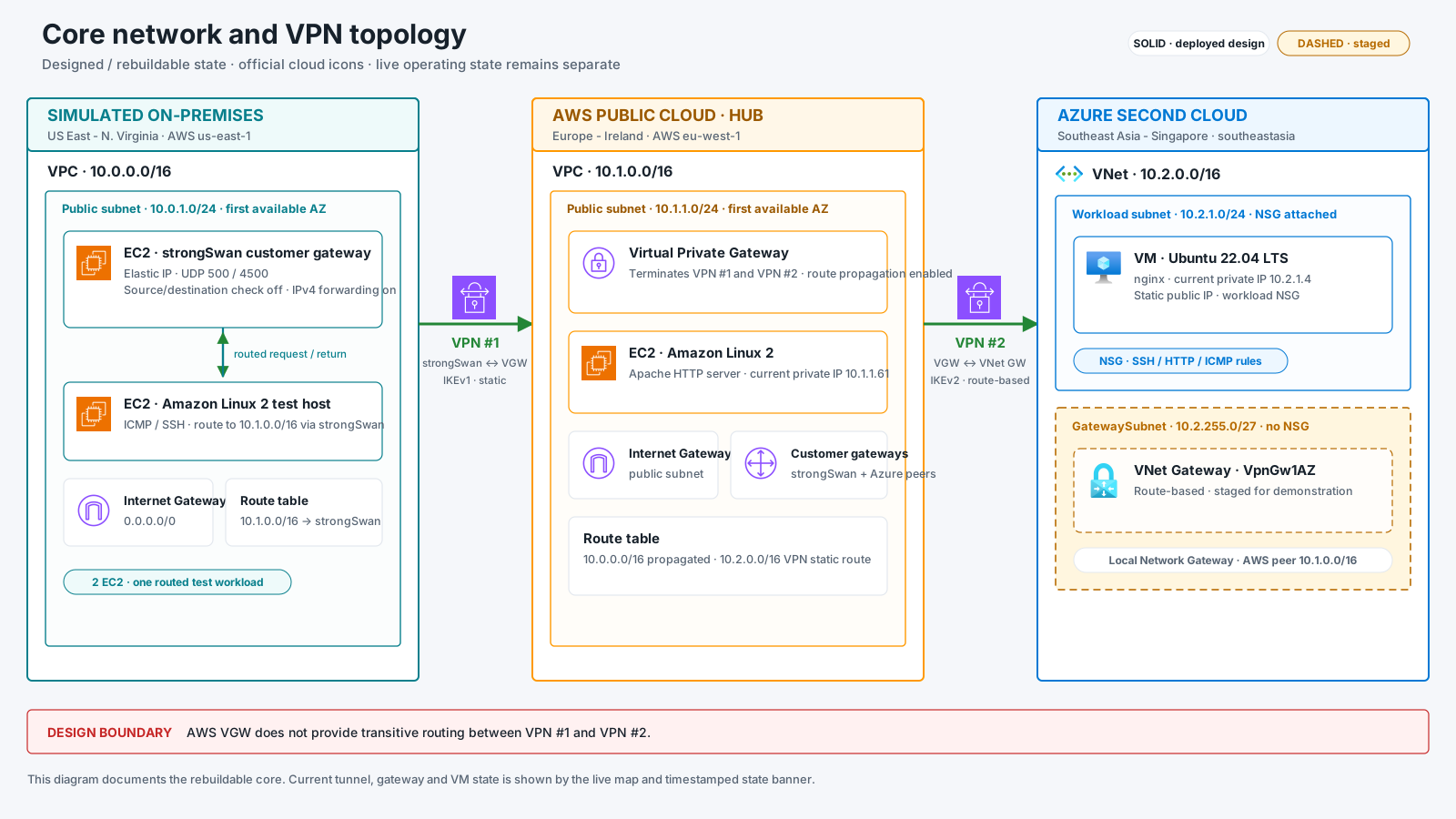
Deployed design reference, not a substitute for live telemetry. The diagram follows the reconciled CloudFormation and Bicep design: Virginia has one public subnet; the Ireland application entry spans public subnets in eu-west-1a and eu-west-1b; Azure has one workload subnet and one GatewaySubnet. VPN #1 and VPN #2 are the current encrypted paths. The strongSwan EC2 owns the Elastic IP, has IPv4 forwarding persistently enabled and source/destination checking disabled, and routes traffic for the separate Amazon Linux 2 ICMP/SSH test host. Provider-managed addresses can change after rebuilding, and the VGW remains deliberately non-transitive. The live map and state banner above are authoritative for current availability. Open editable vector · Open historical commissioning capture.
2 · Two-AZ ALB application resilience · Test 10

Current school-deployment evidence. Test 10 abruptly stopped Web Node 1 in eu-west-1a while Web Node 2 in eu-west-1b remained registered and healthy behind the same ALB. Across 203 one-second samples, 198 returned HTTP 200 and five transient failures were retained while ALB health detection converged in 36.8 seconds. Both targets were restored healthy. This proves two-AZ application-target resilience; it does not claim a whole-AZ, ALB, VPC, VGW or regional failure, and it does not claim zero interruption. Open Test 10 recording.
3 · Live evidence and public-dashboard pipeline
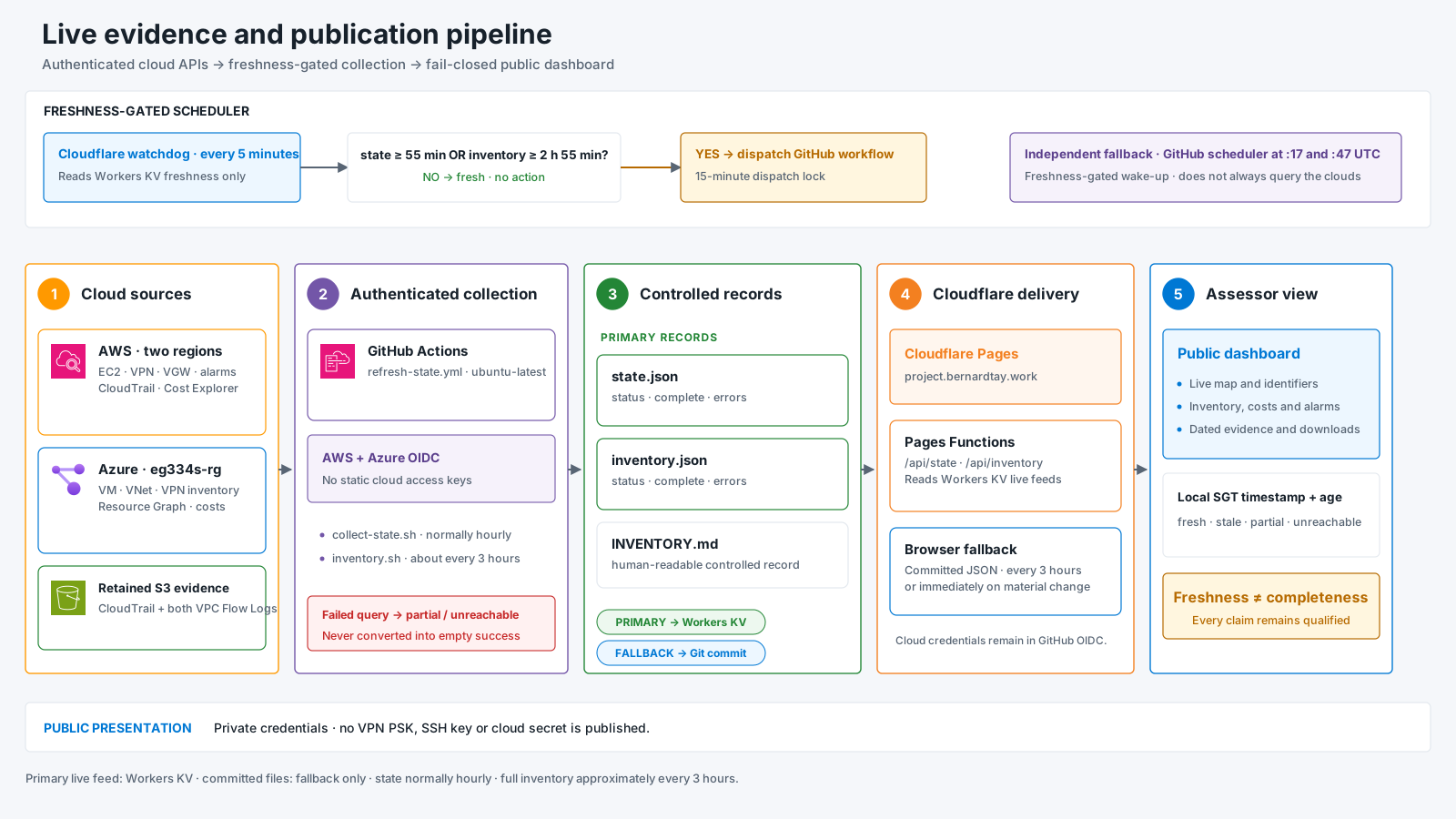
Why the public evidence is trustworthy. GitHub Actions uses AWS and Azure OIDC to collect state normally hourly and the larger inventory approximately every three hours. Complete, error-aware JSON is written to Workers KV as the primary path; committed files are the browser fallback. The Cloudflare watchdog checks KV every five minutes and dispatches a freshness-gated workflow only when needed, while the native GitHub schedule is an independent fallback. The dashboard distinguishes fresh, stale, partial and unreachable: freshness never substitutes for completeness, and no VPN PSK, SSH key or cloud credential is published. Open editable vector.
4 · Cross-cloud build sequence
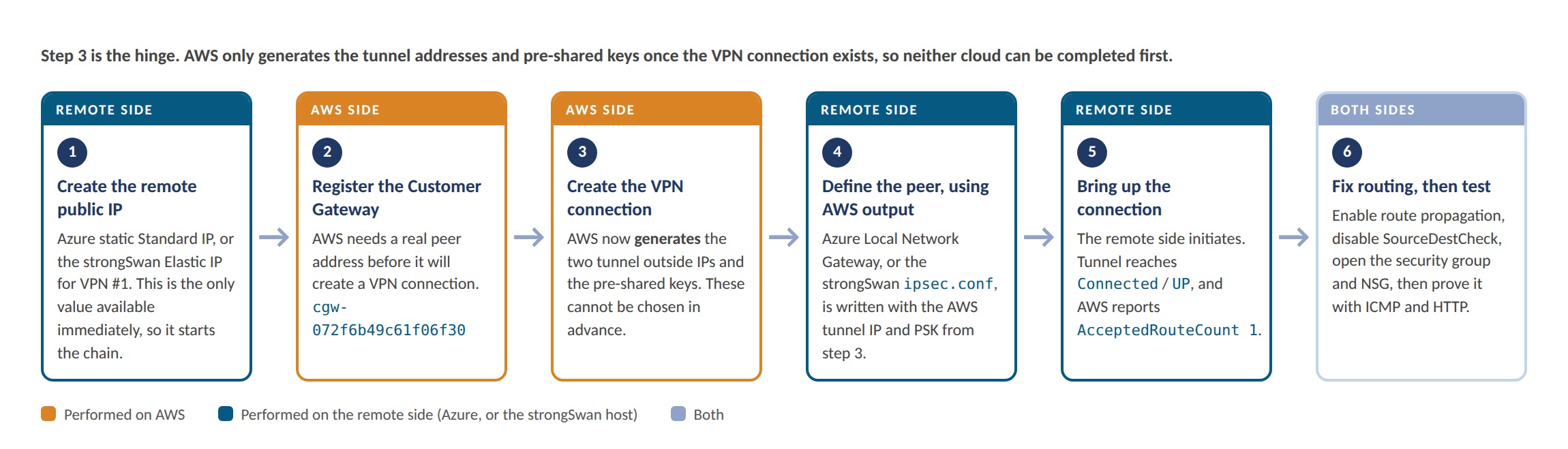
Figure 6.1. The cross-cloud build order. Step 3 is the hinge: AWS only generates the tunnel addresses and pre-shared keys once the VPN connection exists, so neither cloud can be completed first. The seam has to be walked once, in order, by hand.
5 · Supporting service catalogue · report Figure 5.7
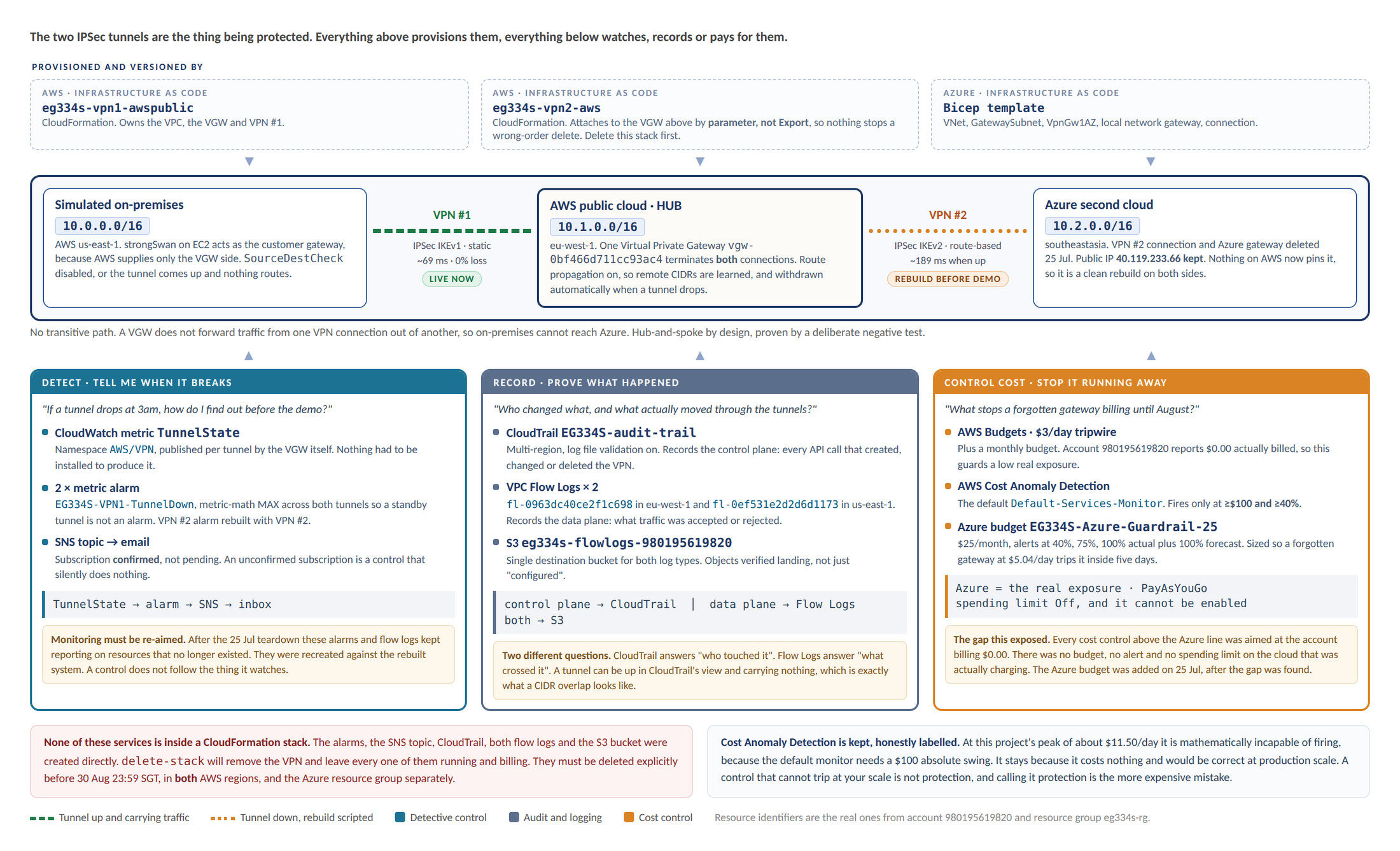
Figure 5.7. The VPN environment and the services around it. The two VPN connections are the assets being protected; AWS supplies two tunnel endpoints for each connection. The current templates define both VPC Flow Logs, the multi-region CloudTrail, SNS and both VPN alarms. AWS Budgets and the CloudWatch dashboard remain separate account-level controls. The retained central S3 bucket is intentionally left after stack deletion until evidence is preserved and it is explicitly emptied and removed. Current deployed ownership must be proved from describe-stack-resources; until a complete inventory succeeds, it is TBD rather than assumed. Open the ownership matrix.
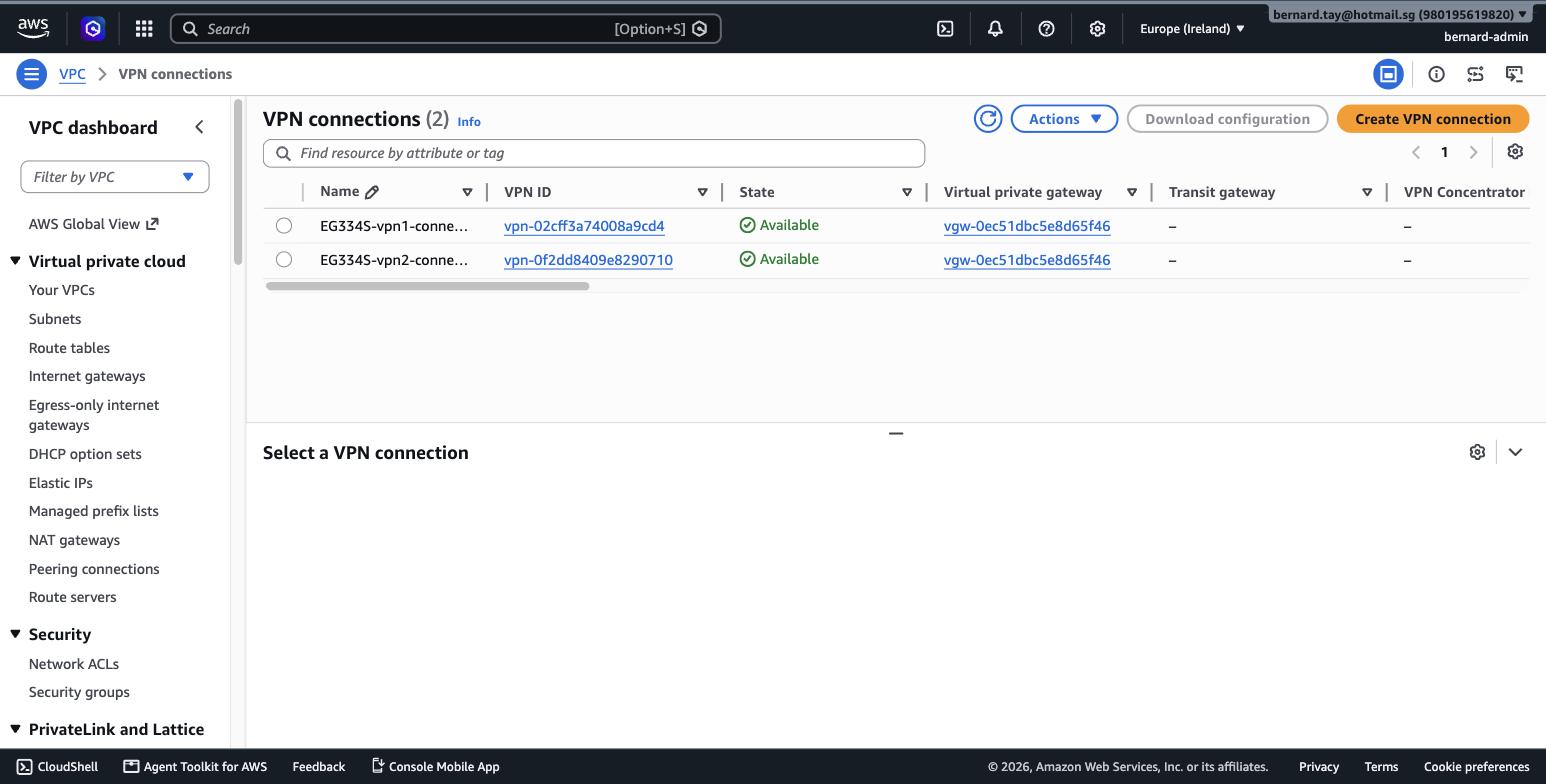
Test results · authoritative Tests 1–12 register
1. VPN #1 data planePASS · on-prem to 10.1.1.119, 0% loss, ttl 254, ~69 ms
2. VPN #1 IPSec SAPASS · ESTABLISHED, INSTALLED, ESP in UDP (NAT traversal confirmed)
3. VPN #2 data planePASS · Azure 10.2.1.4 to 10.1.1.119, 0% loss, ttl 254, ~189 ms
4. VPN #2 application layerPASS · HTTP from Azure returned the AWS web server page
5. VPN #2 Ireland → Azure private pathPASS · 4/4 ICMP replies, 0% loss, 213.206 ms average RTT; supporting HTTP 200
6. Ireland ALB baseline · two healthy targetsPASS · two healthy targets across eu-west-1a and eu-west-1b; HTTP 200
7. VGW transitive routing boundaryEXPECTED FAIL · VPN #1 traffic is not forwarded through VPN #2, correct by design
8. Monitoring, audit and traffic flowVERIFIED · both Flow Logs active, CloudTrail logging, three alarms OK and SNS configured
9. IaC and teardown dry-runVALIDATED / DRY-RUN · five non-administrator YAML templates, one administrator-only reference and two Bicep builds passed; 40-file package, checksum manifest and read-only teardown check passed
10. Abrupt ALB Application-Target Failure with Health-Check ConvergencePASS WITH OBSERVED TRANSIENTS · 198/203 HTTP 200; five retained errors; both targets restored
11. Demand-driven Auto ScalingPASS · one to two to one instances; ALB health verified and baseline restored
12. VPN #2 preferred-to-standby resiliencePASS · preferred endpoint DOWN, standby UP; 240/240 private ICMP and 240/240 HTTP 200; full restoration verified
Tests 1–6 prove the supported data and application paths and ALB baseline. Test 7 preserves the expected VGW routing boundary. Tests 8–9 separate additional engineering controls and dry-run validation from live traffic tests. Tests 10–11 retain their observed target and capacity behavior. Test 12 proves one recorded VPN #2 standby-path continuity run; its zero failed probes are not a guarantee of future zero-loss behavior.
5ControlsWhat stops this going wrong quietly.
Security & monitoring · detective controls live (Bernard · Security/Monitoring)
CloudWatch alarms
3 OK
Secondary capacity, VPN #2 tunnel state and ALB unhealthy-host detection.
CloudTrail
logging
multi-region · log-file validation on
VPC Flow Logs
2 × ACTIVE
both AWS VPCs → S3, objects delivering
SNS alerts
configured
eg334s-team2-monitoring-alerts exists in eu-west-1eg334s-team2-Hub-Secondary-Capacity-Low
OK
GroupInServiceInstances confirms the active secondary capacity remains available.eg334s-team2-alb-UnhealthyHostAlarm
OK
UnHealthyHostCount reports no unhealthy ALB targets at the latest collection.eg334s-team2-VPN2-TunnelDown
EVIDENCE
eg334s-team2-vpn2
The alarm evaluates the school VPN #2 connection. The live banner remains authoritative if the environment changes after this collection.
CloudTrail
eg334s-team2-audit-trail VPC Flow Logs
fl-089ba53487f044bc8 (eu-west-1) + fl-0e9369512e0289153 (us-east-1)CloudWatch dashboard
NOT DEPLOYEDNo project CloudWatch dashboard was returned by the school account API. The three alarms above remain active; this is a presentation-layer gap, not a monitoring outage.
SSH posture
The 25 Jul deployment is restricted to one administrative
/32 on the on-premises hosts, with no public SSH ingress on the hub server. The published CloudFormation templates have no permissive default: deployment requires an explicit valid /32, and scripts/validate-iac.sh rejects an open administrator default.Security groups decide what is allowed. Alarms, trails and flow logs decide what is noticed. The VPN #2 alarm firing on a real outage is stronger proof than a pair of green ticks: it shows the detection path works end to end, from metric to alarm to SNS to inbox.
Cost monitoring · guardrails active (Bernard · Security/Monitoring)
Checking billing APIs…
Azure · month to date
loading
Azure for Students · consumption draws down the student credit
AWS Team 2 · estimated spend
loading
Month to date · project attribution estimate
AWS monthly budget
$296.90
Monitoring threshold only · not a credit or hard spending cap
Azure student credit
$100 initial
Azure for Students · spending limit on · remaining balance is portal-authoritative
AWS account
427617722186 · school account · authenticated identity 2298683WAWS budgetactive ·
Monthly Cost Budget · $296.90 monthly threshold. It sends alerts; it does not allocate credit or stop resources.AWS creditsNo Credit or Refund line is visible to this account in Cost Explorer. Treat the usage as chargeable unless the school payer administrator confirms centrally held credits.
Unattended refreshadministrator action pending · the school-account GitHub OIDC read role is still required. Manual authenticated refreshes remain available and fail closed.
Azure subscription
Azure for Students · AzureForStudents_2018-01-01 · subscription a1e9ac34-fc76-410c-8b6f-0f652af83dbbAzure student credit$100 initial credit · spending limit On. Usage is deducted from that credit; the Education Hub or Sponsorships portal is authoritative for the remaining balance.
Azure budgetnone configured at the checked resource-group scope. The subscription spending limit remains the hard protection against conversion to paid overage.
How these numbers were obtained. AWS month-to-date usage comes from Cost Explorer and includes the current estimated tax line when returned. Azure month-to-date consumption comes from the Cost Management ActualCost API. The AWS budget comes from AWS Budgets; Azure subscription type and spending-limit status come from Azure subscription metadata.
Interpretation. These are school AWS and Azure for Students figures for August—not costs from the retired personal environment. Provider cost feeds lag operational telemetry, and the displayed amount is not a remaining-credit balance.
How fresh can this be? Azure Cost Management returns same-day data, though the current day keeps trickling in for several hours. AWS Cost Explorer lags a day or more and flags its figures as Estimated. So "live cost" does not exist on either cloud. What is real time is the resource inventory, which is what actually matters for catching something left running. Any team member with the documented read-only access can run ./scripts/refresh-cost.sh; it fails closed if either cloud login or a required billing field is unavailable.
Control lesson. The Azure student credit and spending limit reduce financial exposure, while the AWS budget is alert-only. No account-visible AWS credit should be assumed. Stop or deallocate optional compute between attended tests, but retain the VPN gateways only when continuous connectivity is required.
Risk watch · the things that actually bite
Owner means whoever can actually act. The programme manager tracks every risk on this list and chases all of them, but only owns the ones where he holds the lever. A risk assigned to someone who cannot discharge it is not managed, it is just parked.
!
Key-person dependency · OPEN · automation uses short-lived OIDC access and the verification tools are now shared in this repository, but the interactive demo sessions, SSH keys and recovery access have not been proven from a second device. Backup operator: TBD by the team by 12 Aug. Closure evidence is a complete rehearsal in which Bernard does not operate the environment.
!
Section ownership · DECISION PENDING · the current report order and owner mapping are a working proposal. This is deliberately labelled provisional rather than treated as fact. Decision owner: full team; coordinator: Casper; target: 7 Aug checkpoint. Closure requires one accountable owner per section, an approved Responsibility Assignment Table and matching dashboard/readiness records.
!
Shared group presentation · TEAM REVIEW READY · one 12-slide deck now carries the assessment-aligned business case, common technical narrative, provisional speaking map, assessor Q&A and sourced speaker notes. Next action: each member validates the technical statements they may present; the full team confirms the order and ownership before rehearsal.
!
Live cross-cloud cost exposure · the Azure VpnGw1AZ and VPN #2 are live. Action: keep the environment only for the approved demonstration window, monitor the live billing cards, and use the dependency-ordered teardown after assessment. Owner: Bernard.
!
Decommission slippage · the brief states a real mark penalty for AWS resources left after 30 Aug 23:59 SGT. Stack ownership is now reconciled: delete
eg334s-team2-secondary, then eg334s-team2-alb, eg334s-team2-hub, eg334s-team2-onprem and finally eg334s-team2-rg. The central evidence bucket and Cloudflare evidence-site retention decision remain explicit team/lecturer decisions. Owner: Bernard; second verifier: TBD. See the ownership matrix.!
Public working artefacts · DECISION PENDING · the team-review report and shared group deck are publicly downloadable under the user's explicit approval. The full team should still confirm institutional rules and final submission status; both artefacts remain clearly labelled non-final.
✓
Closed · school ALB application-target resilience · Test 10 abruptly stopped Web Node 1 in
eu-west-1a. Web Node 2 in eu-west-1b remained healthy; 198 of 203 one-second requests returned HTTP 200 and five transient failures were retained during the 36.8-second ALB detection window. Both targets were restored healthy. This proves two-AZ application-target resilience, not zero interruption, VGW/VPN failover or regional DR. Open the recording.✓
Closed · report administration · all five administration numbers are present, “Adelene” is corrected, pagination defects are removed, and the current team-review copy renders to 18 A4 pages.
✓
Closed · overlapping CIDRs (locked at M1), evidence debt (captured while live), gold-plating (core proven before monitoring was added), cross-region teardown (documented per region and per subscription).
Claim verification · dated evidence record
Identifiers are reconciled to the accepted school deployment. Current health and cost remain timestamped separately in the live banner.
Accepted school-deployment evidence record. The live banner remains authoritative for current health and cost. The identifiers below are the reconciled school AWS and Azure resources used by the report, shared deck, diagrams and IaC runbooks.
AWS identifiersschool account 427617722186 · VGW
vgw-02efe604037a218cf, current VPN #1 vpn-053c85ebeeb20c115, VPN #2 vpn-0106da6f9a20b1302.Addressesreconciled school deployment · Ireland Web Node 1
10.1.1.119 / 52.213.151.17; current Auto Scaling Web Node 2 10.1.2.146 / 108.130.232.28; Virginia strongSwan 10.0.1.122 / 174.129.120.215; Virginia test host 10.0.1.224 / 54.173.28.32; Azure VM 10.2.1.4 / 20.205.122.51; Azure gateway 20.24.123.36.VPN endpointsVPN #1 uses route-based VTIs for AWS endpoints
34.252.232.43 and 52.208.125.123; both IKEv2/BGP tunnels are ESTABLISHED. VPN #2 uses AWS endpoints 52.51.60.239 and 52.211.121.132; both static IKEv2 tunnels are UP with one accepted route each. Azure uses one active-standby gateway and two connection resources with routing weights 10 and 0.Design assertionscurrent · IPv4 forwarding is retained across reboots and AWS source/destination checking is disabled on the strongSwan router only; GatewaySubnet
10.2.255.0/27 has no NSG; workload subnet 10.2.1.0/24 uses its NSG; the Azure local network gateway identifies Ireland 10.1.0.0/16.MonitoringFour school-account CloudWatch alarms—including VPN #1 BGP tunnel availability—multi-region CloudTrail with log-file validation, two ACTIVE VPC Flow Logs to S3, and SNS alerting are deployed. The live state feed reports current alarm state; it must not be inferred from this static record.
VPN #1 cleanupThe obsolete static VPN and customer gateway were retired on 6 Aug 2026 after BGP acceptance. Open the dated cleanup and verification record.
Current private pathsVPN #1 supports Virginia
10.0.0.0/16 ↔ Ireland 10.1.0.0/16. VPN #2 supports Ireland 10.1.0.0/16 ↔ Azure 10.2.0.0/16. Virginia ↔ Azure is unavailable by design because the VGW is non-transitive.Working artefactsteam review · the 18-page group report, shared 12-slide deck and downloadable IaC package are aligned to the school deployment and remain subject to final team approval.
Test 10 · Abrupt ALB Application-Target Failure with Health-Check ConvergencePASS WITH OBSERVED TRANSIENTS · Web Node 1
i-04d4025fda0bb37b4 was stopped; Web Node 2 i-06305a433e0abbabb remained healthy. Result: 198/203 HTTP 200, five retained transients, 36.8-second detection, then both targets restored healthy. Open the current school recording.Assessment artefacts reviewed. The scope, milestones, report requirements and both assessment rubrics were cross-checked against the supplied official files. The report and deck state the active+standby VPN endpoint model, non-transitive VGW boundary, two-target ALB result and Test 10 claim boundary consistently.
Refresh before presentation. Infrastructure claims decay. Use the authenticated manual refresh until the school-account GitHub OIDC role is created; the dashboard will mark old values stale rather than substitute incomplete data.
6How it endsDecommissioning. This is where marks are lost.
Teardown checklist · run in every region before 30 Aug 23:59
On-prem sim AWS us-east-1
- EC2 private server
- Customer gateway + VPN connection
- VPC, subnets, route tables, IGW
- Elastic IPs released
- Security groups + key pairs
- CloudFormation stack deleted
AWS public AWS eu-west-1
- Delete
eg334s-hub-recoveryfirst - EC2 web server
- Virtual private gateway + VPN conn
- CloudWatch / CloudTrail / Flow Logs
- VPC, subnets, route tables, IGW
- Elastic IPs released
- CloudFormation stack deleted
Azure East Asia
az group delete --name eg334s-team2-rg --yes- Removes VPN gateway (the big cost)
- Removes connection + local network gateway
- Removes VNet, NSG, VM, disks, public IPs
az resource list --tag Project=EG334Sreturns empty
AWS order matters: delete eg334s-vpn2-aws before eg334s-vpn1-awspublic, it borrows that VGW.
School AWS IAM and key-pair cleanup is account-wide, not regional. Confirm project-tagged roles, instance profiles and both regional key-pair records as separate teardown controls.
Two controls that protect the teardown
1 · DEPENDENCY ORDER
Delete the borrower before the owner
eg334s-vpn2-aws borrows the virtual private gateway owned by eg334s-vpn1-awspublic. Delete VPN #2 first so the owner stack can remove the gateway cleanly.
2 · RETAIN EVIDENCE
Prove that nothing remains
After teardown, run the authenticated verification script across both AWS regions and Azure. Retain its PASS / FAIL / ERROR transcript as the M6 completion evidence.
Technical note
VPN #2 borrows the hub VGW by parameter, so CloudFormation does not enforce deletion order across the stacks. Delete the VPN #2 borrower before the stack that owns the VGW.
The shared verification script checks project-named AWS resources and every resource in eg334s-team2-rg, and fails closed with ERROR if authentication or a required query fails. Account-level budgets, key pairs and the public dashboard remain explicit manual controls.
Shared evidence record · technical milestones are source-controlled, not browser-local. Times in Asia/Singapore. Built for EG334S. Live status is in the banner and map above; the update stamp is below.